Few gaming phenomena have captured the global gaming economy quite like Counter-Strike cases. Introduced in the 2013 “Arms Deal” update, weapon cases transformed Counter-Strike: Global Offensive (and now Counter-Strike 2) from a traditional tactical shooter into a massive virtual stock market.
For the uninitiated, opening cases is a thrilling pastime. For veterans and traders, it is a complex economic ecosystem governed by probability, supply, demand, and Valve Corporation’s overarching market design.
This guide explores everything one needs to know about CS:GO cases, how they work, the mathematics behind the drops, and the virtual economy that surrounds them.
What Are CS:GO Cases?
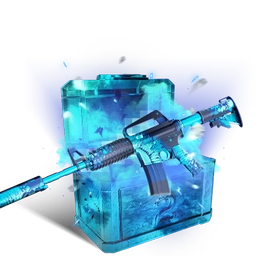
CS:GO cases are virtual containers that hold weapon finishes (skins), gloves, or knives. To open a case, a player requires two things:
- The Case Itself: Dropped randomly during weekly gameplay or purchased on the Steam Community Market.
- A Key: Purchased directly from the in-game store for a flat rate of £2.50 GBP.
Once opened, the player receives a single item determined by a randomized algorithm. The items inside are categorized by rarity tiers, which dictate their visual complexity and market value.
Understanding Rarity Tiers and Drop Odds
The thrill of opening a case stems from the vast disparity in value between common drops and rare treasures. While Valve does not officially publish exact percentages for every single item, community-driven statistical analyses involving millions of opened cases have revealed reliable estimates of drop rates.
Case Drop Rarity Breakdown
| Rarity Tier | Color Code | Estimated Drop Probability |
|---|---|---|
| Consumer Grade / Base | White | N/A (Found in Souvenir/Graffiti, not standard cases) |
| Industrial Grade | Light Blue | ~79.92% |
| Mil-Spec | Dark Blue | ~15.98% |
| Restricted | Purple | ~3.20% |
| Classified | Pink | ~0.64% |
| Covert | Red | ~0.13% |
| Special Rare (Knives/Gloves) | Gold | ~0.26% |
As the table illustrates, hitting the “Gold” tier—a knife or a pair of gloves—occurs in roughly 1 out of every 400 cases.
StatTrak™ and Wear Conditions: Variables of Value
Even if a player manages to pull a rare item, its value is heavily influenced by two major mechanics: Wear Condition and the StatTrak™ technology.
1. Wear Conditions (Float Values)
Skins do not have durability that degrades over time; instead, they are permanently assigned a “Float Value” between 0.00 and 1.00 when unboxed. This float determines the wear category:
- Factory New (FN): 0.00 – 0.07
- Minimal Wear (MW): 0.07 – 0.15
- Field-Tested (FT): 0.15 – 0.38
- Well-Worn (WW): 0.38 – 0.45
- Battle-Scarred (BS): 0.45 – 1.00
For some skins, a higher wear value introduces scratches and fading. For others (like certain “Rust Coat” or “Black Laminate” patterns), high wear is actively sought after by collectors.
2. StatTrak™ Items
Any weapon pulled from a case has roughly a 10% chance of being a StatTrak™ item. These weapons feature a small digital LED counter that tracks the number of confirmed kills made with that specific weapon. StatTrak versions generally command a higher price on the community market than their standard counterparts.
The Economics of the Case Market
The CS:GO (and now CS2) economy operates largely independently of traditional gaming ecosystems. Because items can be bought, sold, and traded on the Steam Community Market and various third-party marketplaces, cases have become speculative assets.
Key economic principles drive the market:
- Active vs. Rare Drop Pools: Valve routinely shifts cases between the “Active Drop Pool” (dropped to players actively playing the game) and the “Rare Drop Pool” (dropped extremely infrequently). When a case enters the rare pool, its supply decreases, and its market price typically rises.
- Trade-Ups: Players can trade up 10 lower-tier skins of the same wear quality for 1 skin of the next higher tier. This burns supply, increasing the rarity and value of top-tier items.
- The Key Factor: Because keys remain pegged at £2.50, the baseline cost of opening a case is fixed. If a case costs £10.00 on the market, the opening cost is effectively £12.50, making the mathematical expectation of return even lower.
Best Practices for Handling Cases
For players navigating the world of CS:GO cases, adhering to a few golden rules can save money and prevent frustration:
- Treat Cases as Entertainment, Not Investment: Statistically, the house (Valve) always wins in the long run. Expect to lose money on openings.
- Buy Singles Instead of Opening: If you want a specific skin, purchasing it directly from the Steam Market or a reputable third-party site is almost always cheaper than trying to unbox it.
- Invest with Caution: If you choose to hold cases as speculative investments, research historical supply trends and understand that Valve updates can drastically alter market values overnight.
Frequently Asked Questions (FAQ)
1. Do CS:GO cases carry over to Counter-Strike 2?
Yes. All cases, keys, and skins from CS:GO carry over directly into Counter-Strike 2, often looking vastly improved thanks to the Source 2 engine’s lighting and rendering upgrades.
2. Can I get a knife from any case?
No. Each case is tied to a specific “weapon case collection.” You must inspect the case contents in-game to see which specific set of knives or gloves are available in that container.
3. What is the most expensive CS:GO case?
Prices fluctuate daily, but older, discontinued cases—such as the Operation Bravo Case or the Huntman Weapon Case—frequently command high prices due to their extreme scarcity and nostalgic appeal.
4. Are third-party case-opening sites safe?
Generally, third-party gambling and case-opening sites operate in a legal gray area and are not endorsed by Valve. Many have strict regional restrictions, and using them carries a risk of account suspension or financial loss. Proceed with extreme caution.
Disclaimer: Case opening involves randomized outcomes and financial expenditure. Always set a strict budget and gamble responsibly.
Explore CS2Skin for the latest Case Skin news, skin insights, and market trends. Discover what makes each case worth opening.